A study of Luke 2:1-7
What I am about to tell you may come as a shock, but I believe it is the cultural and Biblical truth of the birth of our Lord and Savior. As Christians, we have heard the story of the birth of Jesus quite a bit. Every Christmas we pull out the Nativity decorations that represent the birth of Christ and we hang them on trees, place them on coffee tables in our living room, or build elaborate sets on our front lawns. We have the animals, the wise men, Mary, Joseph, and little baby Jesus laying on hay in a manger. We depict this scene as our traditions have taught us to depict it and not necessarily by what actually happened.
The traditional story has told us that Jesus was born in a stable. He was wrapped and put in a manger because there was no room in the “inn” when Joseph and Mary arrived in Bethlehem. Here is the traditional story as we have told it and as it has been told to us: The family travels to this little village called Bethlehem because the census decreed by Cesar Augustus said everyone was to go back to their place of birth to be counted by Rome. This little town of Bethlehem was full of people because of the census and the “Holiday Inn” had no vacancy. What was Joseph to do? He had to do something quick because Mary was about to give birth. Joseph, in haste, decides to put him and Mary in the stable in the back of the Inn, where the animals were housed. There Jesus is born and laid in a manger. That is the story all Christians hear every year during the Christmas holiday, and we tell our children this story because that is how it was told to us. But, how much of this story is actually in the Bible and how accurate is the story we have been told? Was Jesus really born in a stable? This article will examine the scripture to see exactly what it tells us about the birth of the King of Kings, as well as examine a book written about the culture of first century Jews to provide context to the scripture. The Gospel of Luke is where the traditional story of the birth of Christ comes from. The Gospel of Matthew writes about the wise men visiting the baby Jesus, but Luke is focused on where Jesus was born. This is where we will focus our attention. The book I am also going to reference to help add context and historical background to the story is called, “Jesus Through Middle Eastern Eyes: Cultural Studies in the Gospels.” by, Kenneth E. Bailey.
Let us begin by looking at Luke chapter 2. I will be using the NIV as well as Young’s Literal Translation. I chose these 2 versions because they give an accurate translation of the particular text explaining the birthplace of Jesus and offers the closest translation to what Luke wrote. Luke 2:1 “In those days Cesar Augustus issued a decree that a census should be taken of the entire Roman world”. “And everyone went to their own town to register.” Luke 2:3. “So Joseph also went up from the town of Nazareth in Galilee to Judea, to Bethlehem the town of David, because he belonged to the house and line of David” Luke 2:4. Verse 5 goes on to say Mary was with child and went with him to Bethlehem. So far, the story from these passages matches what we traditionally hold as the story of the birth of Christ. But, as we read in verse 6, this is where our traditional story begins to decouple from Biblical truth. Let us look at Young’s Literal Translation, as I think it does a better job of explaining the time frame of Mary and Joseph in Bethlehem. Luke 2:6 “And it came to pass, in their being there, the days were fulfilled for her bringing forth”. In our traditional view, we always say they arrived, and Mary was ready to give birth. That is not the case. They had been there for some time as you can read, “in their being there, the days were fulfilled for her bringing forth”. This implies they had been in Bethlehem for some time and were not just “arriving”. The KJV also does a good job translating what happen. It says, “And so it was, that, while they were there…” None of the Gospels, including Luke, tell us how long they had been in Bethlehem leading up to the birth. But, they had definitely not “just arrived”. This idea of “just arrived” is so engrained in our Christian thinking, but where did this idea of arrival and immediate birth come from? The source of this misinterpretation begins with a story told 200 years after the birth of Jesus when an anonymous Christian writer created a story called, The Protoevangelium of James. This story also spawned the myth of him being born in a “cave” that some Christians believe happened, and opened the door for the other myth of Mary arriving in Bethlehem ready to give birth. All of it is fiction and has stuck with the Christian birth story for the last 1,800 years. So, if they had not “just arrived” in Bethlehem and Mary was not giving birth when her and Joseph came into town, what about the “no room in the inn”? First, let us look at Joseph and Mary’s arrival. The arrival of Joseph back to his hometown had to be a big deal. He was a descendent of the great King David. The Jews in and around Judah considered David the greatest King to have ever lived, and though Jerusalem for all intents and purposes was considered the “city of David”, the people in Bethlehem referred to their little village as the “city of David” Luke 2:4. The whole town would have welcomed Joseph and Mary, especially as a mother to be, and anyone would have made accommodations for a descendant of the great King David. Most in Bethlehem would have loved to have them in their home. Also, more than likely there would have been relatives of Joseph living there, so the idea that they could not find room at the “inn” and decided to stay in a stable with the animals is just not true. This idea is found nowhere in the Biblical account of Jesus’ birth. So, where did this idea of Jesus being born in a stable come from? He was placed in a manger and where else would a manger be, but in a stable, right? Well, before we answer that question, let us back up and examine if there was truly an “Inn” in the Biblical account or not. Luke, who wrote the birth story of Jesus, was well versed in the Greek language. He was a physician, so most assuredly he knew the Greek language very well, and he knew exactly what words to use to chronicle what happen in the little town of Bethlehem. Before we dive into the translation though, let us look at the traditional English interpretation that has been with us since 1611 from the KJV and then go back to the NIV and Young’s Literal. KJV – “And she brought forth her firstborn son, and wrapped him in swaddling clothes, and laid him in a manger; because there was no room for them in the inn” Luke 2:7. Did Luke use the word “inn”? It is in the KJV, but is this what Luke wrote? The Greek word used by Luke was Katalyma which simply means “a place to stay” and can refer to many types of shelters. This Greek word katalyma was used for “house” in the Arabic Biblical tradition for more than one thousand years, as well as, guest room which was Luke’s choice when using the word Katalyma (Jesus Through Middle Eastern Eyes: Cultural Studies in the Gospels.” by, Kenneth E. Bailey pg.32). Now, you might be saying well a guest room could be an Inn or what today we call a Hotel room. Yes, but there was a separate Greek word for a “Commercial Inn” or what we call a “Hotel room”, and Luke could have used that word, but he did not. In fact, let us look at another time Luke used this word “Katalyma”. “He [Jesus] replied, As you enter the city, a man carrying a jar of water will meet you. Follow him to the house that he enters, and say to the owner of the house, ‘The Teacher asks: Where is the guest room [Katalyma], where I may eat the Passover with my disciples?’ He will show you a large room upstairs, all furnished. Make preparations there” Luke 22:10-12. This is why both the NIV and Young’s Literal Translation Bibles use “guest room” instead of “Inn”. Young’s actually says “guest chamber”, but I think you get the idea. Okay, so the word Luke used in Luke 2:7 was Katalyma, and it does not mean “Inn” or “Hotel”, it means guest room. As I said earlier, there is a Greek word for a “commercial Inn” or what we call a “Hotel”. The word is Pandocheion, and the first part of the word means “all” and the second part as a verb means “to receive” (Jesus Through Middle Eastern Eyes: Cultural Studies in the Gospels.” by, Kenneth E. Bailey pg.32). Pandocheion is the place that receives all like a “commercial Inn”. As stated before, Luke knew the Greek language and knew what words to use in his writings. Let us look at an example of when Luke used the word pandocheion for “commercial inn”. Luke 10:25-37 when the Samaritan takes the wounded man to a “commercial inn”. Luke 10:34 says, “He went to him and bandaged his wounds, pouring on oil and wine. Then he put the man on his own donkey, brought him to an inn [Pandocheion] and took care of him”. If Luke meant “Inn” back in Luke 2:7 then why didn’t he use the word pandocheion? He did not use this word because it was not an “Inn” that Joseph and Mary could not get into, it was a guest room they could not get into. The guest rooms of all of the houses were probably full because people had come back to their hometown to register for the census. Bethlehem was a small village and if all of the relatives came back to stay with their families, it made for quite a crowded place. So, if guest room was not a hotel, then what was it?
During the time of Jesus, a simple village home was made up of 2 rooms, a “family room”, and a “guest room”. The main room of the little house was the “family room” where the entire family ate, cooked, slept, and lived. The second room was the guest room, and that room was exclusively for guests. Ancient Middle Eastern cultures had a large capacity to show honor to invited guests. This tradition goes all the way back to Abraham; Genesis 18:1-8 (Jesus Through Middle Eastern Eyes: Cultural Studies in the Gospels.” by, Kenneth E. Bailey pg.36). So, to accommodate travelers and guests, villagers and families living in and around Judea would attach a guest room to the end of their house with its own door for privacy. Another option would be to build a “prophet’s chamber”, which would be on the roof of the house, as described in 1 Kings 17:19 (Jesus Through Middle Eastern Eyes: Cultural Studies in the Gospels.” by, Kenneth E. Bailey pg.28). Looking at the ancient style house, you would see two doors in the front. One door would lead into to the “family room” and the other into the guest room. As you walked into the front door of the “family room”, there would be what we would call a “stable”. This “stable” area would be lower than the rest of the “family room” and would have a few stairs leading up to the main area. This recessed space was designed for the family livestock. This area by the door would hold the family’s animals at night to keep them and the rest of the house warm as well as keep thieves from taking the animals if they were left outside. The family could have a cow, maybe a few sheep or a donkey. Here is an illustration (Jesus Through Middle Eastern Eyes: Cultural Studies in the Gospels.” by, Kenneth E. Bailey pg.29) of the side of a typical village home that Jesus and His family would have stayed in while in Bethlehem.
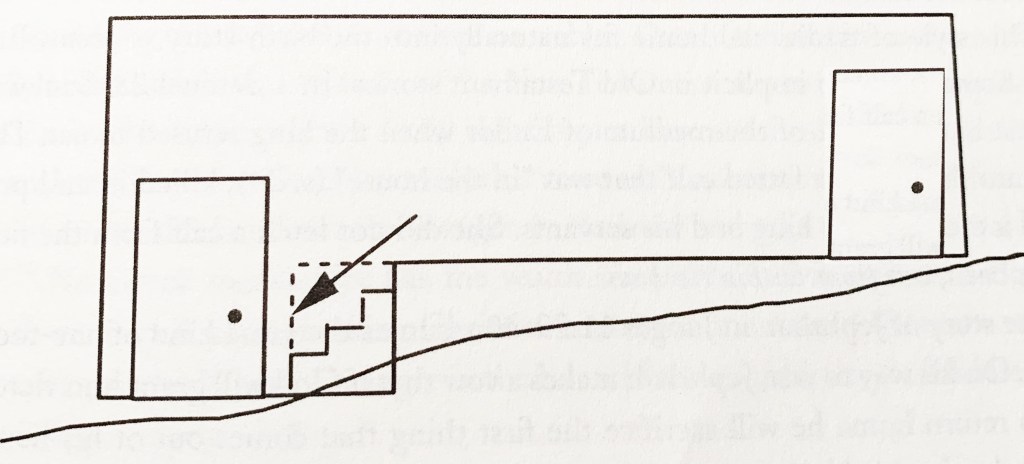
“The door on the lower level serves as an entrance for the people and animals.” (Jesus Through Middle Eastern Eyes: Cultural Studies in the Gospels.” by, Kenneth E. Bailey pg.29). The people would go up the stairs to the “Family Room” and the animals would stay down by the door. Here is the same village house but illustrated above looking down.

The two circles in the above illustration are “mangers” dug out of the lower end of the “family room”. As Kenneth E. Bailey references “the family room would have a slight slope in the direction of the animal stall or what we might call a “stable”, which aids in sweeping and washing. Dirt and water naturally move downhill into the space for the animals and can be swept out the door” (Jesus Through Middle Eastern Eyes: Cultural Studies in the Gospels.” by, Kenneth E. Bailey pg.30). Kenneth E. Bailey states to the “Western mind the word manger invokes the words stable or barn. But in traditional Middle Eastern villages, this is not the case. People of great wealth would naturally have had separate quarters for animals. But simple village homes in Palestine often had two rooms.” (Jesus Through Middle Eastern Eyes: Cultural Studies in the Gospels.” by, Kenneth E. Bailey pg.28). He goes on to state that “such simple homes can be traced from the time of David up to the middle of the twentieth century.” “I have seen them both in Upper Galilee and in Bethlehem.” (Jesus Through Middle Eastern Eyes: Cultural Studies in the Gospels.” by, Kenneth E. Bailey pg.29)
Notice in the illustration that the guest room has its’ own door. The guest of the house could come and go as they pleased without disturbing the rest of the family or the animals. Luke in his writings about this event was no doubt referencing this style of home you see above and not a “commercial inn” or animal stable. The family room would have been more than adequate to accommodate Joseph and Mary as she gave birth, and though it would have been crowded, especially if the animals were with them, it would have served God’s purpose perfectly as did the manger to hold the baby. The guest room was full just as Luke said, so Mary and Joseph had to stay with the family in the “family room”. I am sure the women were prepared and ready to assist in bringing forth Jesus into the world, so Joseph did not have to do it all by himself.
With these facts laid out before you I ask, what is so wrong with Jesus born into the normal surroundings of a peasant home with family and friends celebrating His birth? To the people of Bethlehem, Jesus was from the line of David so, they would have taken great care of the mother and the baby. Leaving the family alone in the stable to give birth is not at all what the Jewish cultural would have allowed. They took care of their own, especially a pregnant Jewish woman. Also, if the people of Bethlehem knew their scripture, they would have recognized who He was going to be. Micah 5:2 – “But you, O Bethlehem Ephrathah, who are too little to be among the clans of Judah, from you shall come forth for me one who is to be ruler in Israel whose coming forth is from old, from ancient days”. Examining the cultural aspect of the birth of Christ, as well as examining the language of the birth story told by Luke, gives us reason to doubt our traditional Nativity story. And I ask, what is so wrong with that?
 Crack A Bible