3 full days in the grave, but how?
Christian tradition says that Jesus was placed in the grave on a Friday and raised from the dead the following Sunday. We call His crucifixion and burial “Good Friday” and His resurrection “Easter Sunday”. Celebrating these two days, “Good Friday” and “Easter Sunday”, have been part of our Christian faith since the mid-second century. Although the actual dates we celebrate fluctuate year to year. In the 20th century, several attempts were made to arrive at a fixed date, but never came to fruition. The dates we celebrate today range from March 22nd to April 25th following the first full moon after the spring equinox. Though church organizations around the world have tried to nail down a date, it has been for naught. In November 2022, the Patriarch of Constantinople said that the “conversations between the Roman Catholic Church and the Orthodox Churches had begun to determine a common date for the celebration of Easter”. The agreement is expected to be reached, in conjunction with the 1700th anniversary of the Council of Nicaea, in 2025. (https://en.wikipedia.org/wiki/Easter) It will be interesting to see where they land, given the back and forth that has been going on for almost 1,800 years.
We Christians love to argue and discuss different aspects of the Bible no doubt. But my purpose here is not to convince you of which date Easter should be celebrated, but instead challenge your traditional thought on when Jesus was placed in the grave after His death on the cross. His resurrection was on a Sunday, no disputes in the church over that. But many arguments have been had of when Jesus was placed in the grave. These arguments, from what I can tell are based on traditions rather than Biblical facts, and I want to dispel the traditional thought that has disguised itself as truth and show what the New Testament says about when Jesus was taken off the cross and placed in the grave. Examining various Old and New Testament scriptures, we can get to the real day Jesus was placed in the tomb and not rely on tradition to guide our theology. To find the answer we need to know where to look and apply the correct time.
Where to look? Most Christians assume that when they see the word “Sabbath” in the passages covering Jesus’ crucifixion that they all apply to Saturday, but this is not the case. There were 2 extra Sabbaths associated with the “Feast of Unleavened Bread”, which God commanded in Leviticus 23, and they could fall during the week depending on when the Passover was celebrated. What do I mean by this? This “Feast of Unleavened Bread” was the day after Passover and lasted for 7 days (seven in the Bible is the number of perfection). The Passover was on the 14th day of the first month of the year for the Jewish nation (see Exodus 12). The month was called Nisan and the 14th signified the day God brought them out of slavery in Egypt. The first day of the feast of unleavened bread started on the 15th of Nisan and God proclaimed no normal work would be permitted on this day. Again, this was the first day of the feast of unleavened bread. Then He proclaimed on the 7th day of this feast there would be no normal work permitted, just like every Sabbath Saturday. If the 1st and/or 7th day of the feast of unleavened bread happened to fall on a Saturday, well then, the Jews didn’t get any extra days of rest. This was not the case during Jesus’ death, and it just so happened that a day of “no normal work permitted” fell before the Saturday Sabbath. The week Jesus was crucified, the Jews got 2 days of no work. These 2 Sabbaths came after Passover during the feast of unleavened bread, and they were called “High Sabbath”. John 19:31 in the ESV calls it a “high day” and the NIV says, “special Sabbath”. These “High Sabbath” days were treated just like a normal weekly Sabbath that came every Saturday. Now, do you see the confusion? So, the passages in Luke (23:54), Mark (15:42), John (19:31,42), and Matthew (27:62) telling us about when Jesus was taken off the cross and why the Jews were in such a rush to get Him in the grave was not because of the Saturday Sabbath that was coming, but because it was a special Sabbath that came after Passover, which was the feast of unleavened bread. Jesus was crucified on the Passover and the next day would be the feast of unleavened bread and that first day was a rest day commanded by God (Leviticus 23). Now that I have shown what Sabbath these passages are referencing, let’s look next at the correct timeline. Examining these 2 things when the High Sabbath happened and how the Jews at the time of Jesus counted their days, will lead us to the correct day Jesus was placed in the tomb.
Applying the correct time. The New Testament states many times that Jesus will be raised up on the 3rd day or “in three days”, but Jesus talking to the Pharisees and Scribes saying, “For just as Jonah was three days and three nights in the belly of the great fish, so will the Son of Man be three days and three nights in the heart of the earth”. Matthew 12:40. He is telling them 3 FULL days in the tomb. So, how does this line up with our traditional thought about Good Friday? If Jesus was put in the grave on Friday and raised on Sunday, that could, at the most, only be 48 hours. Even that seems like a stretch. To get 72 full hours, it would have to have been on Thursday. So, is this true? Was He laid in the tomb on Thursday? Timing is everything when dealing with when Jesus was laid in the grave. How did the Hebrew people view a 24-hour time frame? When did their 24-hour days start and end? To be fair, there was no such thing as exact 24-hour days during that time, and you will see why in a second. For understanding, I will say 24-hour days. Okay, we first need to look at Genesis 1:3-30, the creation of the Earth. Each time God created something, it is ended by “there was evening and there was morning”. This was to communicate how each day was counted. These passages in Genesis were written in such a way as to convey that each new day started in the evening and not when the sun came up, like we do today. Well, technically we say a new day starts at midnight, but you get the gist. The Jewish days were counted starting when the sun went down not when the sun came up. To illustrate and to prove why this is what the Jews followed based on scripture here is an excerpt from “Evening or Morning: When does the Biblical day begin?” by J. Amanda McGuire.
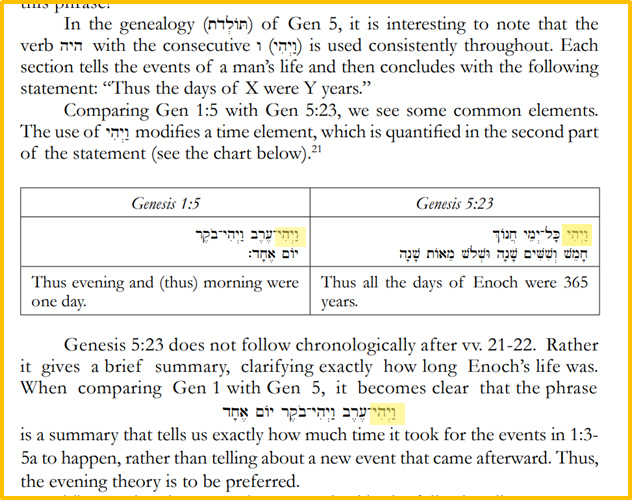
If you look at Genesis 5:23 it does not follow chronologically after verses 21-22, but gives “summary clarifying exactly how long Enoch’s life was”. This is further evidence that the Hebrews measured days starting in the evening. Now, to see this clearly you must compare the Hebrew words within the writing which I have highlighted from J. Amanda McGuire’s essay (pg. 4). When Genesis 5:23 is compared with Genesis 1, it is the same characters used conveying a summary of how much time it took for the events to happen, “rather than telling about a new event that came afterward. Thus, the evening theory is to be preferred.” Evening to evening was how the Jews kept time. Look at John 19:42 and Luke 23:54 as the “High Sabbath” would begin at sundown, which was to a Jew the next day. Joseph of Arimathea was trying to get Jesus down from the cross and into the tomb before sundown because that was when the High Sabbath was to begin. The evening-to-evening constituting 1 full day, roughly from 6PM to 6PM or sundown to sundown.
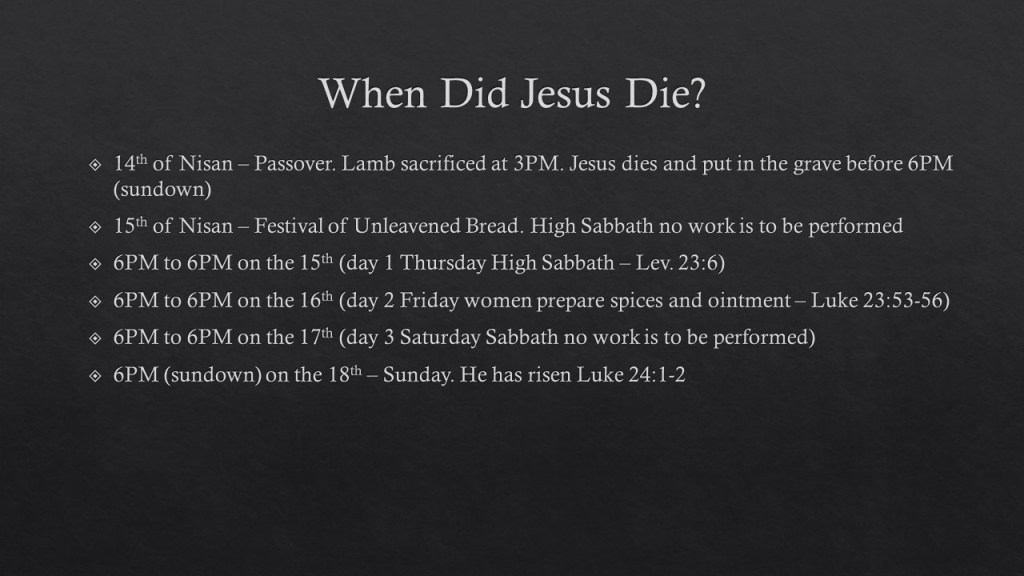
Jesus told the Scribes and Pharisees in Matthew 12:40 that just as Jonah spent 3 days and 3 nights so would the Son of Man. That is 3 full complete days and in Jewish terms that meant sundown to sundown. Some theologians have claimed that this was a parable or that He did not mean a literal 3 full days, but Jesus was stating a fact, not hyperbole. He rose from the grave after sundown on the 3rd day, which to a Jew at the time would have been Sunday. If we look at it in terms of our weekdays, not how we keep time and meaning our weekdays based on Jewish 6PM to 6PM days, then we get Jesus was crucified and laid in the grave right before sundown on Wednesday. Thursday in the tomb from 6PM to 6PM is 1 full day and 1 full night. Friday in the tomb 6PM to 6PM is 2 full days and 2 full nights. Also, on Friday the women prepared the spices and ointment because they could not do it on Thursday because it was a High Sabbath and they could not do it on Saturday because that was a weekly Sabbath, so Friday was when they spent the time preparing for what they would bring to the tomb on Sunday Luke 23:53-56. Saturday in the tomb 6PM to 6PM is 3 full days and 3 full nights.
This was God’s plan from the beginning and everything that happened around the crucifixion, death, and laying in a tomb was perfectly executed by our almighty God. I hope you will read all the passages I have called out to help get a clear picture of the timing. It is truly amazing, how unbeknownst to Jonah, he was setting up the prophecy that Jesus would fulfill 787 years later. How Awesome! Also, I would like to propose on that day in 2025, the anniversary of the Council of Nicaea, that when the churches meet that we move the day back 2 days and we celebrate starting on Wednesday. You think they’ll go for it?
 Crack A Bible